 THE FIRE LAB · OFFENSIVE DEFENCE
The worst place to charge an e-bike is the way out.
London’s e-bike fires are falling for the first time, and America is writing rules for the cheap chargers and spare batteries behind many of them. Neither deals with the biggest risk in a block of flats: a battery charging in the hallway between the residents and the street.
In a block of flats, an e-bike is heavy and home is two floors up. So it gets charged wherever it is easiest to leave it: the entrance hall, the corridor, the space under the stairs. In most buildings, that is the only way out.
A lithium battery that fails does not burn like a chip pan. It heats itself from the inside, very fast and with little warning, and gives off toxic smoke. It does this whether anyone is awake or not. At the bottom of the stairs it does not just start a fire. It closes the escape route before anyone upstairs knows they need it.
The London Fire Brigade’s figures make the point better than we can. Five people have died in these fires in London since 2023. The Brigade records that not one of them owned the e-bike involved. They lived in the same block.
THE LONDON NUMBERS
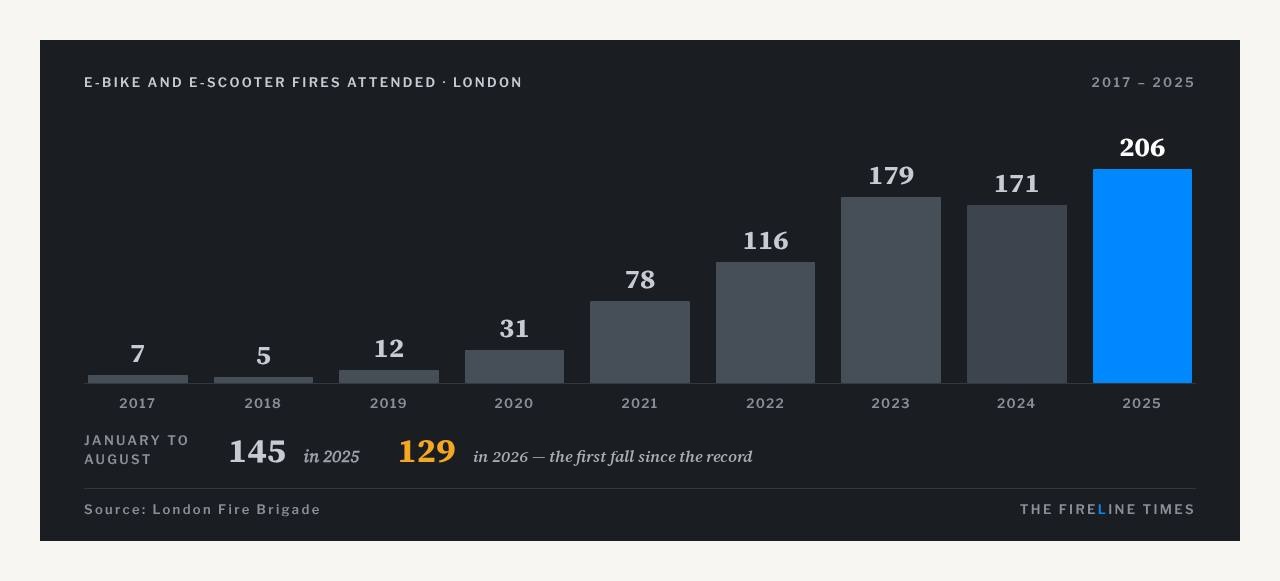
London had 206 e-bike and e-scooter fires in 2025, the most since the Brigade began counting. That is a crew going to one roughly every other day. Eight years earlier, in 2017, there were seven.
This year the number has turned. From January to August the Brigade attended 129, against 145 in the same months last year. The Brigade puts it down to three years of campaigning about safe charging, including roadshows this year that reached more than 3,500 delivery riders, the people most likely to be charging a tired battery in a shared hallway.
THE RULES ARE CATCHING UP
On Wednesday the United States Consumer Product Safety Commission heard evidence on a proposed law for e-bike and e-scooter batteries. For the first time it would cover replacement batteries, chargers and conversion kits sold on their own, which is where much of the trouble starts. It would also stop a battery charging while its cells are still hot. The Commission counts 227 incidents in the five years to the end of 2023, and 195 of them were fires.
Britain is on the same road. A government consultation on new powers closed in June, and a fast-tracked British safety specification for e-bike, e-scooter and conversion-kit batteries has been commissioned.
India, the biggest two-wheeler market in the world, went through this in 2022. A run of e-scooter fires led to a government inquiry, which blamed the cells and battery packs rather than the riders, and the national battery standard was tightened. That changed what leaves the factory. It cannot change where a five-year-old scooter is charged.
WHAT TO DO
That is the gap. A law can change what is sold, and a campaign can change habits. Neither can move a bike out of a hallway. That is down to the people who live in and look after the building, and the advice is plain.
Keep e-bikes and e-scooters out of corridors, entrance halls and stairwells. Charge them while you are awake and nearby, not overnight. Use the charger that came with it. Replace a battery that has been dropped, damaged or has started to swell.
None of that is a product, and none of it is ours.
SOURCES
London Fire Brigade, Record number of e-bike and e-scooter fires across London in 2025, 28 January 2026 · London Fire Brigade, ChargeSafe and Deliveroo rider roadshows, October 2026 · United States Consumer Product Safety Commission, notice of proposed rulemaking, Safety Standard for Lithium-Ion Batteries Used in Micromobility Products, 91 FR 38162, 24 June 2026, docket CPSC-2025-0012 · CPSC, notice of opportunity for oral presentation, 91 FR 63208, 5 October 2026 · Product Regulation and Metrology Act 2025 · Indian government inquiry into electric two-wheeler fires, 2022, and AIS-156 as amended.